Signs of a Rat Infestation in Your Leeds Property
Rats are highly cautious creatures. By the time many homeowners in Leeds become aware of their presence, an infestation is often already well established. Brown rats — Rattus norvegicus, the most widespread species across the UK — are predominantly nocturnal, preferring to travel along walls, beneath flooring, and through concealed spaces, rarely venturing into open areas unless population pressure forces them to do so.
Because of this behaviour, the earliest warning signs are seldom the rats themselves. Instead, what becomes noticeable first is the evidence they leave behind — droppings, physical damage, distinct odours, and audible activity.
Identifying an infestation at an early stage can significantly limit the extent of damage, reduce health risks, and make treatment more straightforward. This guide outlines seven key indicators to watch for in a Leeds property, along with associated risks and an overview of how professional rat control is carried out.
Apex Pest Control provides BPCA-accredited rat control across Leeds and the wider Yorkshire region. If you suspect rats, call our Leeds team on 0113 390 4270.
1. Rat Droppings
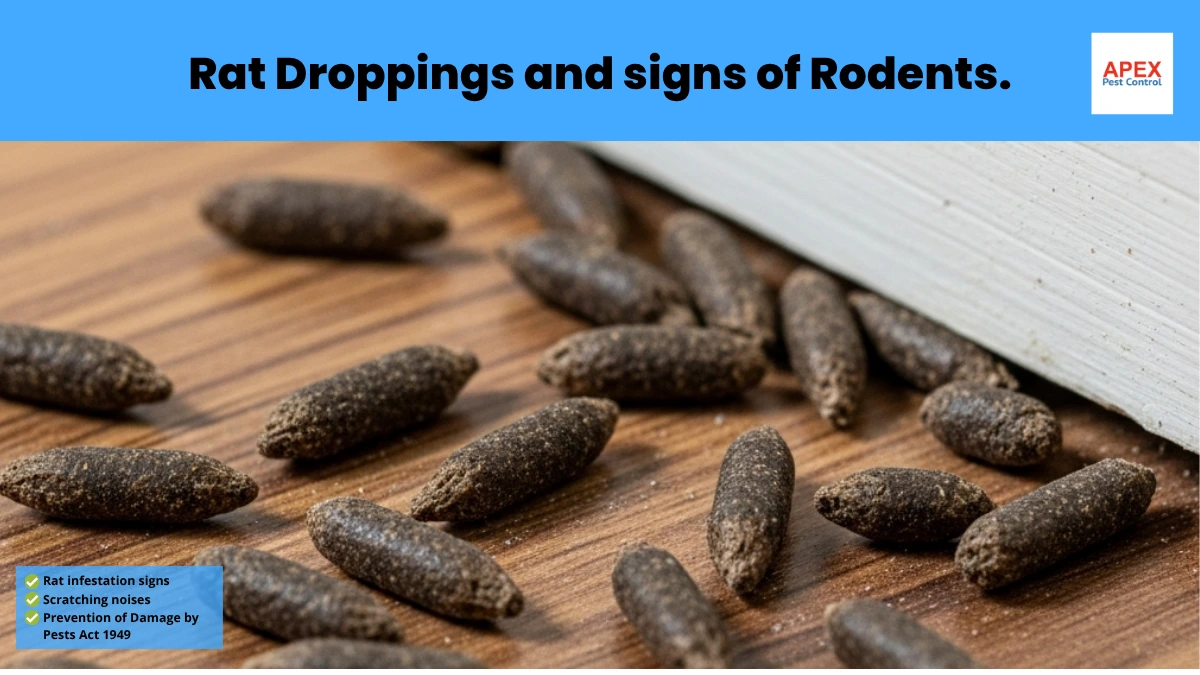
One of the earliest and most definitive signs of rat activity is the presence of droppings. Brown rats can produce up to 40 droppings each night, typically leaving them in concentrated areas along their established routes — behind appliances, beneath kitchen units, inside cupboards, within loft spaces, and along skirting boards.
What to look for:
- Dark brown, capsule-shaped pellets approximately 8–12mm long
- Tapered at both ends, resembling a large grain of rice
- Fresh droppings are moist and dark; older droppings become dry, hard, and paler
- Concentrated clusters near food storage, water sources, or nesting areas
The presence of droppings in multiple areas suggests prolonged activity and unrestricted movement throughout the property. A single cluster close to an entry point may indicate early-stage infestation.
If droppings are discovered, avoid sweeping or vacuuming them without protective gloves and a face covering, as they may carry Salmonella and other harmful pathogens.
2. Gnaw Marks and Structural Damage
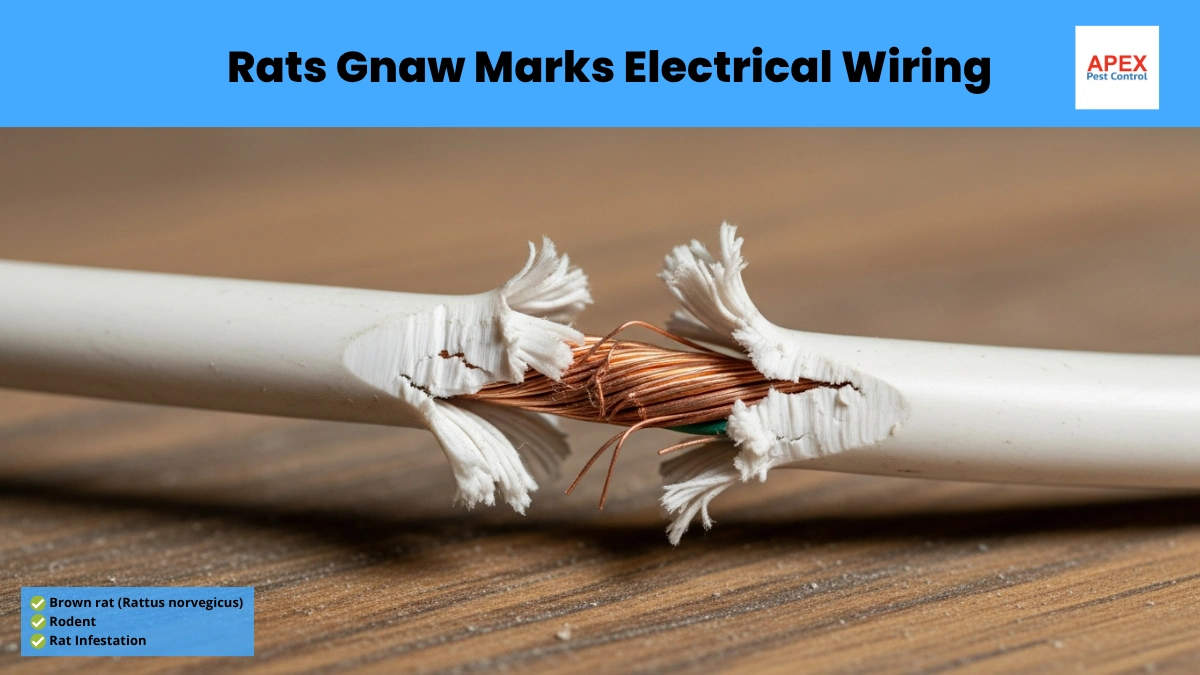
Rat gnawing damage on electrical wiring highlighting potential fire risk
Rats must gnaw continuously to control the growth of their incisors, which leads them to chew through a wide range of materials — including wood, plastic, pipework, and electrical wiring.
Where to check:
- Skirting boards, door frames, and wooden beam edges
- Chewed wires and electrical cables behind walls, in loft spaces, and under floors
- Plastic waste pipes and water supply pipes beneath sinks
- Food packaging in cupboards or storage areas
Gnaw marks created by rats are typically larger and more irregular than those caused by mice. Fresh damage appears pale and splintered, while older marks darken over time. Exposed wiring should be treated as an immediate fire hazard and assessed by a qualified electrician alongside pest control intervention.
Rodents are considered a contributing factor in a notable proportion of unexplained electrical fires across the UK. Under the Prevention of Damage by Pests Act 1949, property owners are legally required to manage rat activity on their premises.
3. Grease Marks and Smear Trails
Due to limited eyesight, rats rely on established routes, travelling the same paths repeatedly along walls and edges. As they move, oils from their fur leave behind dark smear marks.
Where to look:
- Along skirting boards and wall edges at floor level
- Around pipe entry points and gaps in floorboards
- On beams, joists, and rafters in loft spaces
- Around holes or gaps in walls where rats are entering
In undisturbed or dusty environments such as lofts, garages, and cupboards, footprints or tail drag marks may also be visible alongside these smears. Pets displaying persistent interest in specific areas — such as walls or cupboards — can also signal underlying rat activity.
Fresh marks tend to appear dark and slightly greasy, whereas older ones become dry and less distinct. Clearly defined runs indicate consistent and ongoing use.
4. Scratching Noises
As nocturnal animals, rats are most active during the night. The sounds they produce are often one of the clearest signs of their presence, particularly when they remain hidden within wall cavities, under floors, or in loft spaces.
What you might hear:
- Scratching and scurrying sounds from within walls, ceilings, or under floorboards
- A low grinding or chattering noise — brown rats grind their teeth when stressed
- Burrowing sounds from beneath concrete, paving, or under sheds in the garden
- Movement sounds that are loudest in the early hours of the morning
If noises are heard from multiple locations or appear to be increasing, this often indicates a growing population. Daytime noise, especially in loft areas, may suggest the infestation has reached a level where normal behaviour patterns are disrupted.
5. Burrows and Nesting Materials
Brown rats are natural burrowers. Outdoors, they create tunnel systems for shelter and nesting, usually located beside solid structures such as walls, paving edges, sheds, or compost bins. Entrances typically measure 6–9cm in diameter, with smooth edges and visible soil displacement leading away. Depths commonly range between 30–45cm.
Indoors, nests are constructed using shredded materials such as insulation, cardboard, fabric, and paper, usually in quiet areas close to food and water sources. Typical locations include:
- Beneath kitchen appliances and behind fitted units
- Inside wall cavities and between ceiling joists
- In loft insulation
- Under bath panels and behind boxing around pipework
A nest that is warm, dry, and lined with fresh material indicates active occupancy. Disturbing it without proper control measures can cause rats to disperse further throughout the property.
6. Unusual Smells
Rats continuously urinate as they move, marking territory and communicating with others. In an established infestation, this results in visible staining and a strong ammonia-like odour, particularly noticeable in confined or enclosed areas such as cupboards, lofts, and wall voids.
As numbers increase, the intensity of the smell also rises. In more severe cases, a decomposing odour may be present if rats have died within hidden spaces.
Pets often detect these scents before humans do. Unexplained behaviour — such as scratching, staring, or heightened attention toward walls or cupboards — may indicate activity that is not yet obvious.
7. Rat Sightings — What It Really Means
Spotting a rat, whether indoors or outdoors, is often assumed to be an isolated occurrence. In most cases, this assumption is incorrect.
Brown rats typically avoid open environments and human interaction. Seeing one during daylight hours, especially inside a property, usually indicates that population levels have increased to the point where competition is forcing them into visible areas.
A daytime rat sighting inside a Leeds property should be treated as a confirmed infestation requiring professional attention — not a one-off event.
While sightings in gardens are more common and do not always mean rats have entered the home, they do indicate activity nearby. Without intervention, this can escalate — particularly during colder months when rats seek shelter indoors. In Yorkshire, activity levels tend to peak between October and February.
The Risks: Why Leeds Property Owners Must Act Fast
Rats present serious health hazards through contamination of surfaces, food, and water via their urine and droppings.
Key health risks:
- Leptospirosis (Weil’s disease) — A bacterial infection spread through rat urine contaminating water or soil. In England, an average of 57 laboratory-confirmed cases and 89 probable cases are reported annually (UKHSA, 2020–2023). Around 10% of leptospirosis cases develop into Weil’s disease, which can cause kidney failure, liver damage, and in rare cases death.
- Salmonellosis — Spread through rat droppings and urine contaminating food preparation surfaces. Rats leave faecal matter invisible to the naked eye on every surface they cross.
- Listeriosis — Listeria monocytogenes is carried by rats and can contaminate food preparation surfaces, posing a serious risk to vulnerable individuals including pregnant women and the immunocompromised.
- Property damage — Chewed electrical wiring creates fire risk; gnawed pipework causes flooding; burrowing can undermine paving and structures.
There is also a legal dimension. The Prevention of Damage by Pests Act 1949 places a legal obligation on property owners and occupiers to control rats on their premises and to notify the local authority if an infestation poses a risk to health or property.
Why DIY Rat Control Rarely Works in Leeds?
Rodenticides available to the public are generally first-generation anticoagulants. While these may reduce small infestations, they are rarely sufficient to eliminate an established colony. Rats that survive initial exposure often become wary of bait, making future control efforts more difficult.
Why DIY approaches fall short:
- Consumer products do not address entry points — rats will re-enter from drainage, gaps around pipework, or damaged brickwork
- Consumer rat traps placed without a full survey frequently miss primary activity areas and fail to clear an established colony
- Without proofing work, a property remains vulnerable to re-infestation
Professional pest control includes a full inspection, targeted treatment, ongoing monitoring, and preventative measures to ensure long-term resolution.
Professional Rat Control in Leeds — What to Expect from Apex
Apex Pest Control provides BPCA-accredited rat control across Leeds, including LS1 to LS29 and surrounding areas. Our Leeds-based technician Nathan carries out initial surveys, treatment, and follow-up visits.
Rat pressure is particularly high in Leeds’s inner-city areas. Headingley, Chapeltown, Beeston, and Harehills consistently report elevated rat activity, driven by dense Victorian and Edwardian terraced housing, HMO concentrations, and the River Aire corridor which connects the urban centre to surrounding agricultural land.
Approximately 70% of rat infestations in Leeds are linked to drainage faults
A structural issue that consumer products cannot address without a professional drain inspection and proofing survey. Peak rat season in Yorkshire runs from October to February as falling temperatures push rodents indoors.
Our rat control process:
- Survey — Full inspection of the property to identify entry points, active runs, nesting sites, and the extent of the infestation. A fixed-price quote is provided on the same visit.
- Treatment — Professional-grade rodenticide applied in tamper-resistant bait stations at all identified activity points. No call-out fee.
- Monitoring visit — Return visit to assess activity, replenish bait as needed, and confirm the infestation is under control.
- Proofing advice — Recommendations to seal entry points and reduce harbourage to prevent re-infestation.
All treatments use products approved under the Control of Pesticides Regulations 1986 and are conducted in line with the CRRU UK Code of Best Practice on rodenticide stewardship. Apex holds BPCA, CHAS, NPTA, and Lantra accreditations and the Defender Award, and carries £5 million public liability insurance.
Call our Leeds team: 0113 390 4270
Frequently Asked Questions
How do I know if I have rats rather than mice?
Rat droppings are significantly larger than mouse droppings — approximately 8–12mm compared to 3–6mm for mice. Rat burrows are also much larger (6–9cm in diameter versus 2–3cm for mice), and rub marks from rats are heavier and more pronounced. Sounds from rats tend to be louder and include burrowing and grinding in addition to scurrying.
How quickly can a rat infestation grow?
Brown rats can produce 8–14 litters per year with 2–8 offspring per litter. Under good conditions, a small group of rats can multiply significantly within weeks. Early intervention is always easier and more cost-effective than treating an established colony.
Can I leave it and see if they go away on their own?
Rats will not leave a property voluntarily if food, water, and shelter are available. Without removal of the infestation and identification of entry points, numbers will continue to grow.
What does professional rat treatment cost in Leeds?
Apex provides a fixed price at the survey stage with no call-out fee. Contact us on 0113 390 4270 for a same-visit quote.
How long does rat treatment take to work?
In most cases, activity reduces significantly within 7–10 days of treatment and ceases within 2–3 weeks. A monitoring visit confirms clearance.

Spotted the Signs? Call Apex Pest Control Leeds Today
If you have identified one or more of the signs above in your Leeds property, early action is the most effective response. Apex Pest Control’s Leeds team provides BPCA-accredited rat control with no call-out fee and a fixed price given at survey.
Call Nathan and the Leeds team: 0113 390 4270
Lines open Monday–Friday 8am–6pm, Saturday 9am–1pm.
